Twittering Machine

Saturday, August 29, 2009

amsterdam 1


My travel guru Cierlene Benipayo- Justice B.'s sister and Ogie's aunt- had been insisting these past two years that I visit Amsterdam.

Why Amsterdam? I would ask.

To smoke pot legally, see the Red Light District...

Ho-hum.

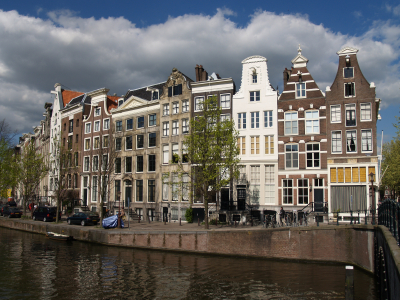
I thought I'd already seen it all, but after I tried the hemp hand lotion of The Body Shop in the Amsterdam train station (which I haven't smelled in Manila- attention The Body Shop Philippines!) and later saw the city's tall, improbably thin 17th century townhouses (which presaged New York's vertical architecture), I felt, if not love, then something close to it: a bond, a connection. 

Here is the actual embodiment of the ideals of my college years: a place with the highest respect for freedom and human rights, the town of Anne Frank in the country of "Big Brother" where people can see what others are doing and yet follow the principle, "Live and let live." No wonder Joma Sison chose to live in exile in this country.

And I remembered I. who, during one lazy afternoon in the green fields of Ateneo when we decided to give it a try, disclosed that she actually stayed with Joma here in the Netherlands. I was captivated by her description of the colorful flowers and gardens of Europe which she read from her diary- in a way, she colored my perception of the continent. She said those flowers were so beautiful, they made her cry- as an activist, because she remembered the faces of poverty back home, but I suspect also as an artist, because they awakened her senses and touched her core.

Though I'm not visiting Joma- my politics and sympathies are much too different now- the faces of his two brothers are very much with me, especially Tito Mon, who succumbed to lung cancer recently. The picture above shows them in Tito Mon's Beverly Hills home, where I stayed during my trip to Los Angeles in the U.S. I miss Tito Mon (you remember him: he's the man on the left)- his stories of Cary Grant and Nora Aunor, his show tunes, his joie de vivre.

It's ironic how close we were to each other- lovers and brothers- yet be politically oceans apart. 

In the microcosm of these relationships, I feel hope and am able to envision unity for our country: we may disagree today, we may have fought each other yesterday, but ultimately we're just one family.
...

Topping my playlist on the plane, something witty, not to mention politically relevant:


Saturday, August 15, 2009

otaku

Finally, I knew a Japanese word that Ronnie-san didn't: otaku (おたく/オタク). After aikido practice, he saw the green streaks of paint on my hair and asked what they were for. I said it was my otaku day.

Otaku is a Japanese word referring to people with obsessive interests, particularly in anime, manga and video games. The term is loosely translated into English as "geek" (there is no close translation in Filipino- an entire generation here was weaned on Voltes V and anime).

Anyway, one morning during a Comics Convention in Megamall, I met this group of Filipino otaku. They reminded me so much of "Densha Otoko," one of my favorite Japanese TV series about the true-to-life love story between an otaku ("Densha Otoko" or "Train Man") and a office worker he met on the train ("Hermes"). With the help of fellow users of 2ch (a Japanese Internet forum where everyone is anonymous), he was able to overcome his shyness, undergo a make-over, and court Hermes. There was trouble, however, when Hermes found out that Densha Otoko was an otaku but- and the TV series became a hit because of this- love found a way to bring them back together in the end. The lesson is simple and resonates in anyone who has ever courted, dated or been in a relationship: just be yourself.

Memorable scenes from "Densha Otoko" are here.

How did it feel to have green hair? This has long been something I've wanted to try- it felt great, I felt instantly transformed into someone new. There's another lesson here somewhere but I'll need to think about that...

Here's the perfect Pinoy otaku song, "Maari Ba?" ("Is It Possible?")- thanks to balladeer Ariel Rivera.


maari ba - ariel rivera

Sunday, August 9, 2009

simbahan


23 August

Dear Father,

Buona sera! Come sta?

I'm just sending a picture of my favorite church in Rome, the Chiesa di San Clemente, where I attended mass tonight. Were you able to celebrate mass there when you were living on one of these Seven Hills? It's much smaller than the other basilicas, and certainly tiny compared to stupendous St. Peter's, but I love the way it defines the many-layered history of the Eternal City. All throughout the mass, I felt transported- as if I were smoking pot in an Amsterdam coffeeshop... I couldn't get over the fact that this simple 12th-century church at street level was built over a 4th-century church that was, in turn, built over a 1st-century Roman house containing a temple dedicated to the god Mithras!

I can only agree when journalist Corrado Augias, who grew up near the Via Appia, writes in The Secrets of Rome (2007),
Where can we begin the story of the universe that is Rome? In a city as contradictory as this, filled with all the glory, ruins, and dust left behind by past centuries, it's possible to see traces of every human event and sentiment in its history- the bravery and cowardice, the generosity and indolence, the resourcefulness and louch limpness of the lazy. There's not a single event in its past that hasn't left a sign, scar, or scratch on its hide. Rome will never be a city of order, symmetry, events that unfold according to plan, or the coherent result of urban planning. If human history is nothing but violence and tumult, then Rome has been its mirror over the centuries, capable of reflecting each and every detail with painful fidelity, including those from which we would willingly look away.
In some ways like Manila, no? But with a longer, even more violent past. Surrounded as you were by classical and baroque art and architecture- and breathing air permeated by a conscious, appreciative enjoyment of fine things, la dolce vita- I couldn't believe you were upset with Cardinal Sin when he personally spirited you here at the height of the authoritarian regime- to save your skin.

On the other hand, I can see why as a priest you would prefer our airy, tropical churches back home: ours may not have the richest decorations, but they are living churches, full of people who fervently hold the faith. In San Clemente's Church, there were less than a dozen of us attending mass with the priest and his sacristan- half of the others in the group were Asians, probably kababayans- and to think that it's a Sunday! 

And when People Power happened in 1986- sunshine would have been heralding the end of winter's chill- how you must have longed to breathe the air of hope and anticipation, to feel the electricity of a multitude that even the wide arms of the Piazza San Pietro would not have been able to contain. Between the ancient chiesas of Rome and the living simbahans of Manila, which is the better choice? Looking at them through your eyes- the eyes of a priest- the answer is as clear and unblemished as the blue tropical sky.

I hope you take solace in the fact that even the late President Cory- most people now call her Tita Cory- wasn't in Manila when People Power happened- the Mother of People Power was praying with the brown caped Carmelite nuns in their convent in Cebu.

You weren't able to visit her wake, were you? I thought of you when I paid my respects- how even as you recognized the shortcomings of Tita Cory as President, how she couldn't stop the self-aggrandizement of some people around her, you respected her as a person. You once recounted how she personally served lunch to you and a fellow priest in her home after your return from exile here in Italy- from the tone of your voice, I would even say you're fond of her. And you were allies in so many causes. And so I wanted to pray for her for you. I didn't know if it was possible, but I remembered how you sometimes made me your spiritual ambassador, how you asked me to send your wishes to people. So I thought I might be able to do it.

I felt like five hundred saints and angels led me through La Salle that night. It was almost midnight and I had heard about the crowds on the radio but I didn't see them. And then I got lost in the darkness- it was my first time in that campus. Each time I reached a gate or a door, however, a guard or usher would smile and open it for me- and when I realized there was a line, and that it stretched forever behind me, I was already near the ramp leading up the gym where Tita Cory's remains lay in repose... I was a bit confused, but the people behind me said nothing and instead pressed me onward...

And then God granted my second wish. We only had a few seconds to view Tita Cory's remains, and there was the distraction of TV cameras and a jumbo screen. But when it was my turn to shuffle past, in the time it took for me to make the sign of the cross, I was able to focus and join my heart to God's, and I felt that your heart was in there praying for her too.

And three Wednesdays ago, for the second time, you and Tita Cory joined the Power of the Multitudes, not physically, but in spirit.

I now have an idea where you are and am mailing this letter to that place- I go there to watch the owls. I hope to visit you after this sojourn to get your advice and blessing. Tomorrow morning, I'll go to Piazza del Popolo and imagine you and Gandhi in conversation while strolling to the top of Pincio Hill. For you, Gandhi, and Tita Cory, I will take in the bella vista of the city where once all roads led.

ArrividerLa and God bless!

Yours truly,
Voltaire

Sunday, August 2, 2009

cory

You ask about my favorite Cory story, but it isn't actually mine.

In high school I had a Filipino teacher named Cris Acuña, a kind and flamboyant man who lit a votive candle at the beginning of every class and who urged us to sing "Lupang Hinirang" out loud whenever we heard this played. From him I learned to read Amado Hernandez, Lazaro Francisco, and our other literary greats.

He had many stories of celebrities who were his students- we were fascinated for example by his observations of the classroom dynamics between Sharon and Pops, then known as rivals in the entertainment field.

One morning- this was Ginoong Acuña's way of holding our attention- he told the story of how he met your mom. In 1983, right after the return of your lola from exile in the US, she enrolled your Tita Kris in our school. I imagine it was September then- too late for enrollment in most Philippine schools, which start classes in June, right after summer. Since most of its students are expat kids, ISM follows the American calendar and begins each academic year in September, making it a viable option for your grandmother and aunt.

G. Acuña said your lola would sometimes accompany Kris to class. Did she wear a yellow dress? we asked. No, she was in mourning and wore black at the time. Where did she sit? She quietly sat in the back of the class. Or she would take a desk outside the classroom, by the soccer field, and sit there enveloped in her thoughts until the class ended.

I like this story, because with the little information G. Acuña gave one can find out so much about your lola: her love for her daughter, her resolve to lead as normal a family life as possible despite the extraordinary challenges she faced, and her simplicity.

Do I have my own story? Well, we led parallel lives: I was growing up, and she was President. My mom adored her, since they shared the same name, Corazon, and yellow is my mom's favorite color. During the early agonizing years of conjugating French verbs, my father mentioned that your lola had actually majored in French, which offered little consolation to me then. I later worked for Sen. Salonga, who headed the PCGG during her term. We also had the same painting teacher, Fernando Sena, though hers was a private class.

But yes I do recall a time when the arc of her life tangentially touched mine, and it was a typically Cory moment.

It happened on February 16, 2003, a Tuesday, in the Supreme Court. Justice Adolfo Azcuna, the presidential spokesperson during your lola's term, was then celebrating his birthday and my officemates said she had been seen in his staff luncheon.

Our office was on the fifth floor and, after lunch, I took the fire exit stairs instead of the elevator to go back- I preferred the fire exit because of the exercise and the relative privacy it afforded. Apparently, your lola thought so too: on the third floor landing, I nearly bumped into her- she wore a finely cut emerald green dress, instead of her trademark lemon yellow, so it took me several nano-seconds to recognize her.

Oh, excuse me Mrs. Aquino, I said.

Do these stairs lead to the lobby? she asked.

Yes, they do...

And, before I could say more, she smiled and disappeared as quickly as any of the secretive superheroes you so love to read about.

Your family has done so much for our country- even now, in this difficult time, you all keep your emotions in check, helping the rest of us hold ourselves together. May your grandparents have peace, and may your family finally have peace and contentment- you are released from the burden of history, we will carry the flame of their ideals in our hearts.

Sunday, July 26, 2009

panorama

I love getting postcards and photos from friends in faraway places- it's like living life many times. Recently, Jerick sent nine panoramic pictures he took of Egypt- they show beauties of a world, but more importantly they reveal the eye and mind of the photographer. This is a mind that, for all the countries it has seen, remains characteristic of the Filipino: it seeks to capture and represent a whole experience, rather than an atomized part of it. It's the same aesthetic that informs the graphic art on our ubiquitous jeepneys.

Here then are nine shots of fabled Egypt, the land of Tutankhamun and Cleopatra, from the viewpoint of a 21st century Filipino:


Sunday, July 19, 2009

editor-at-large

I got a preview of the inspiring plans for Book Development Month of NBDB, led by executive director Andrea Pasion-Flores (seen in the picture with her lawyer-husband Javi). She is multi-talented, having both a law degree and a master's degree in creative writing, but what I see as her greatest trait is her integrity as a public servant. Like J. Mendoza and Sen. Salonga, she raises the standards followed by people around her- she did it as an editor in Collegian and she's doing it as Editor-of-the-Country in NBDB.

With other former Kule colleagues led by Bos Alecks, I got to visit her place again last Friday- it seemed the same as when I last visited it many months ago, with the exception of Javi's burgeoning contemporary art collection and exquisite bonsai forest that he himself tends. I thought of how Kule, despite being an "activist" paper involved in social issues, was like a greenhouse that protected us from a system that we could only understand theoretically.

The good thing about this is that the institution protected our ideals and allowed us to develop a layer in our respective identities that would always be radical, scholarly, and activist. The best model I can think of is Chief Justice Puno, a former Kule Editor who, after reaching the pinnacle of the legal profession, now allows this layer to shine through- the Supreme Court is now engaged in outreach activities that traditionally have been done by NGOs.

Anyway, back to Book Development Month, the proposed theme is "Galing Pinoy, basahin!" and has the following interesting line-up of activities:
  • Lectures and book club sessions on poetry, fiction, and non-fiction by young writers
  • National Book Awards at Ayala Museum, with brass-on-kamagong trophies to be created by sculptor Michael Cacnio
  • Focus on Nick Joaquin: a film screening of "Tatarin" and multi-disciplinary lectures on this National Artist for Literature
  • Global Filipino Literature panel discussion with the winner and finalists of the Man Asian Literary Prize and the Premio Feronia
  • Performance reading of Jose Rizal's El Filibusterismo
  • Novel Writing Contest- possible genres are Pinoy romance, chick lit, and horror fiction
  • Books, Food and Art Festival- the activity I most look forward to, this was inspired by Irish writer James Joyce's Araby and is a three-day literary, food, and art festival in the heart of Makati City
  • Overnight adventure along the Viaje del Sol- touring local art galleries, native restaurants, and pottery centers in South Luzon and participating in a travel writing workshop.
Good luck NBDB!


Subscribe Free
Add to my Page

The poem "Tren (Train)" by Jose Corazon de Jesus from Tulaan sa Tren is posted here under the fair use principle- thanks to NBDB and voice actor Romnick Sarmenta.

Saturday, July 11, 2009

flux

It was the best of times, it was the worst of times, it was the age of wisdom, it was the age of foolishness, it was the epoch of belief, it was the epoch of incredulity. - Charles Dickens, A Tale of Two Cities, English novelist (1812-1870)

"A time of flux," was how one lawyer friend described the pattern of events unfolding in the country.

"A paradigm-shift," described another.

And I thought I was the only one who was feeling the cool wave of change washing over our institutions and collective psyche.

At the center of the political vortex is an ambitious plan to overhaul a creaky and antiquated election system by replacing humans with machines in counting votes and transmitting results to a central computer.

Admittedly, this would probably not solve the following old-school ways of cheating in elections:
  • registration of non-qualified voters
  • disenfranchisement of qualified voters
  • simple vote-buying
  • waylaying of voters through fraud, stealth, or intimidation
  • ballots filled up by only one person or group of persons
  • voting by persons other than by registered voters.
However, the most cost-efficient ways of cheating are minimized or eliminated by poll computerization. Among the problems that poll automation would minimize or eliminate are:
  • vote-buying with chain-balloting or identification marks
  • stuffing of ballot boxes with fake ballots
  • misreading of ballots
  • ballot/ ballot box snatching, destruction or substitution when a candidate is losing in a precinct
  • falsification or tampering of election returns
  • falsification of statements of votes or certificates of canvass in the municipal or city board of canvassers (adding/ subtracting thousands or even hundreds of thousands of votes)
  • falsification of statements of votes or certificates of canvass in the provincial board of canvassers (up to a million votes changed per province).
We are coming closer to the democratic ideal of one person-one vote, away from the current one-candidate-thousands of votes. And some feudal lords are not happy with this development at all.

Already, some of those who had reaped benefits from the old school and whose baronies are threatened by the new school have sought to sow chaos and confusion in Cotabato and other places in the South. It's the classic conflict between regional affiliations and national interests, the rule of lords and the rule of law.

These are the interests that we and our next batch of leaders must balance in the months leading to May 10, 2010. What an exciting time.


Handog ng Pilipino sa Mundo - Various